Scrap metal isnt garbage its a critical feedstock for industry, a carbon-cutting resource, and increasingly a digital-first market. Australias metal recycling sector is growing, driven by demand for recycled aluminium and copper, policy nudges toward circularity, and the rise of online marketplaces that connect sellers with verified buyers. Below youll find a practical, data-backed tour of the market in 2025: size and forecasts, whats driving demand, key challenges, where the opportunities are, and how platforms (hello, ScrapTrade) fit into the picture.
Market snapshot: size & near-term outlook
The Australia metal recycling market was valued at roughly USD 5.07 billion in 2024 and analysts project steady growth through the decade (IMARC forecasts a ~3.9% CAGR to 2033). IMARC Group
Australia also exports substantial volumes of scrap metal for recycling government figures show scrap metal exports accounted for millions of tonnes recently, with major destinations in South and Southeast Asia. That export flow remains important but is also under policy scrutiny as Australia seeks to add local processing capacity. DCCEEW
Whats driving demand right now
- Decarbonising steelmaking (more EAFs) Electric Arc Furnaces (EAFs) use scrap steel as a primary feedstock; as domestic producers expand EAF capacity, they increase demand for ferrous scrap. Recent industry moves and capacity expansions show Australia leaning into lower-carbon steel production. The Australian
- Infrastructure & construction activity Urban development, infrastructure projects, and housing continue to generate large volumes of ferrous scrap and underpin demand for recycled steel. 6Wresearch
- Circular economy policy pressure Federal and state initiatives to improve waste recovery and reduce landfill are pushing more metal into recycling streams. The national waste reporting and circularity targets are nudging industry behaviour. DCCEEW+1
- High-value non-ferrous streams Copper, aluminium and specialised e-waste materials fetch premium prices; theyre crucial feedstocks for electrification and electronics manufacturing. Industry spot checks and recycler price lists put copper at the top of profitability charts. VIC Star Metal
Key numbers & price signals (what sellers should watch)
- Market value: ~USD 5.07B (2024). Forecasts point toward mid-single-digit growth over the next decade. IMARC Group
- Export volumes: scrap metal exports remain material (millions of tonnes), with major export markets across Asia. Watch export policy changes they affect domestic supply and pricing. DCCEEW
- Price volatility: ferrous prices are sensitive to global steel cycles; non-ferrous (copper, aluminium) respond to electronics demand and renewable/EV build-outs. Local scrap price lists and marketplace dashboards are the best real-time indicators. VIC Star Metal+1
Structural challenges the sector faces
- Contamination & sorting costs. Mixed scrap reduces yield and requires extra processing; clean and sorted material sells for more.
- Logistics & scale. Ferrous scrap is heavy transportation accounts for a big chunk of landed cost, especially from regional collection points to processing facilities.
- Price sensitivity. Steel and metal markets are cyclical. Sellers who time sales with market peaks (or pool volume) capture better margins.
- Regulatory shifts. Proposed or actual changes to waste export rules, compliance burdens, and environmental standards can rewire flows quickly. DCCEEW+1
Where the clear opportunities are (practical for sellers & businesses)
- Bulk aggregation from construction & demolition. Large, consistent loads of clean ferrous scrap attract industrial buyers and better rates.
- Non-ferrous specialization. Sorted copper, clean aluminium (remeltable), and separated brass/zinc command strong premiums. Preparing materials (stripping insulation, removing non-metal parts) pays off. VIC Star Metal
- E-waste streams. Circuit boards, power electronics, and cable harnesses contain valuable recoverables; partnering with certified e-waste processors is key.
- Value add with preprocessing. Investing in shredding or separation increases the grade and price per tonne a recycler will pay. 6Wresearch
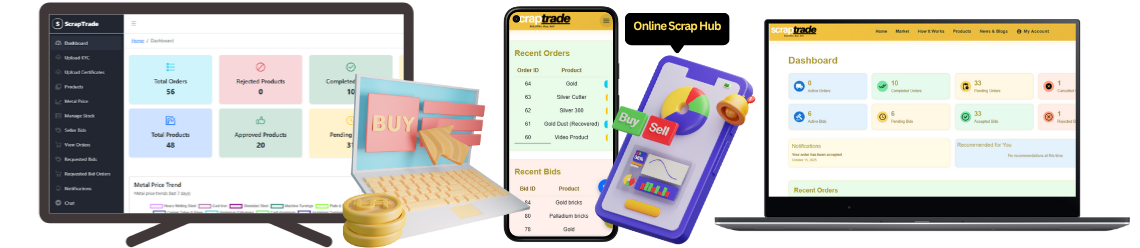
How online marketplaces (like ScrapTrade) change the game
Digital platforms reduce friction in four big ways:
- Price discovery & competition: Multiple verified buyers bid on the same lot that competition drives prices up compared with single-buyer local deals.
- Verification & payment security: Vetted buyers and escrow payments cut counterparty risk. That security is especially important for high-value non-ferrous loads.
- Logistics coordination: Integrated pickup, carrier matching, and tracking shrink transport headaches and hidden costs.
- Market access: Small sellers suddenly reach industrial recyclers and export buyers theyd never meet locally.
If youre supplying scrap in volume, listing on a trusted platform usually nets better returns than a one-off yard sale provided you present clean, accurately described material. (Yes, photos matter.) IMARC Group+1
Policy watchlist (what could move the market)
- Scrap export rules: Moves to limit unprocessed scrap exports would raise local processing demand good for domestic recyclers, possibly better pricing for local sellers. DCCEEW
- Circular economy targets: Federal/state programs that require recycled content in procurement increase steady demand for secondary metals. Australian Bureau of Statistics
- Incentives for EAF & low-carbon production: Policies and funding for decarbonised steel manufacturing boost ferrous scrap intake. The Australian
Quick checklist for sellers who want better returns today
- Sort: keep ferrous and non-ferrous separate; label alloys if you can.
- Clean: remove tyres, plastics, or excessive contamination.
- Bulk: consolidate into larger lots where possible.
- Timestamp: check live market prices before listing.
- Use verified marketplaces: escrow and buyer vetting protect you and help you win better bids. VIC Star Metal+1
Final verdict: outlook to 2028
Australias metal recycling market is structurally strong: policy momentum, electrification/EV demand, and industry moves to EAF steelmaking are positive tailwinds. Prices will remain cyclical, and logistics/processing investments will separate the winners from the also-rans. Sellers who present clean, graded material and use proven marketplaces will capture the most value in 20252028. IMARC Group+1
Want a practical next step?
If you collect, process, or sell scrap metal in Australia, heres a two-line action plan:
- Sort and photograph your next load; list it on a verified marketplace so buyers compete.
- If you handle volume, evaluate preprocessing investments (shredder/separator) the per-tonne uplift often pays for itself quickly.
Need help converting this into a city-targeted page (e.g., Melbourne metal recycling market or Brisbane ferrous buyers) with local slugs and meta tags? I can spin those out next quick, modular, and SEO-tuned.
Sources & further reading
- Australia Metal Recycling Market report IMARC. IMARC Group
- National Waste & Resource Recovery Report 2024 (Australia Government). DCCEEW
- Scrap metal market outlook & industry commentary (Runabout Metals). Runabout Metals
- Australia metal recycling market reports & forecasts (6Wresearch). 6Wresearch
- Most profitable metals to recycle in Australia (industry price guidance). VIC Star Metal